Drupalcon

It is that phase of my life! I'm just turning 30 in a month, working with Drupal for 7 years and just had my third Acquia anniversary a week ago. Time to look back and evaluate how things went, all the good and bad things; even better if the wisdom can be shared with others. This was part of my thinking when I submitted the session titled "Come for the software, stay for the community" for Drupalcon Copenhagen. I was interested to distill and share how Drupal came to be as unstoppable as it is, what core values lie behind it, so someone coming fresh can understand and integrate with these.

When Dries Buytaert started Drupal he made a few key decisions which launched the project and kept being governing principles ever since. First of all he decided to make it free and open source, and release it under the GPL. The choice of one single license helps you use all the Drupal components together without the requirement to consult lawyers. Also, the choice of GPL in particular ensures that derivative works are distributed in the open as well.

Using PHP as the base technology was probably the best decision to help proliferation. PHP is not only the most installed backend software (thanks to all kinds of server side software), but its also easy to learn and jump into. While this can and did end up with some projects that gave PHP a bad name, it also opened the door wide to contributors. Having numerous contributors encouraged the tinkering, technology experimentation spirit that defined Drupal from the gate. What's more, Drupal was an integration platform from the beginning. Even Drupal 3 (in 2001) included RSS generation and consumption, a distributed and automated website directory and tagging. Drupal 4 (in 2002) added Jabber user account integration, XML-RPC services support and Drupal shared authentication. See, Drupal had lots of the base features we praise it for even 8-9 years ago. Woo!

Having a technologically advanced system that people can contribute to easily is not enough. You want to build a culture of building on top rather than forking to avoid the bad fate of many other systems grown up through the years. Establishing the hook system on the API level and the node system on the content handling level formed a good foundation to let people tinker even with the innards of Drupal without ever needing to fork.

Building a big home for all these contributions was the next major idea that distinguished Drupal from many other projects. Drupal itself was built on a sharing cultural mindset and drupal.org was set up for all kinds of contributors to follow suit: release code, designs, tools under the same licenses with the same issue handling system, etc. This helped people move between projects of their interest, contribute to each other's work. Having a strong central base versus everybody's own little kingdoms around the internet jumpstarted the large Drupal ecosystem. In 2009, we had above 2200 new projects started on drupal.org, that is above 6 per day.

Keeping the community all together, Drupal could embrace a culture of change as well. Drupal core could be rearchitected with every major release and have tools to help contributors keep up with the flow. This way Drupal can be at the forefront of innovation both in core itself but even more in contributed modules and themes. As Drupal itself keeps improving, contributed modules are forced to rethink their approaches, purpose, and get better in the process. Old and cumbersome solutions vanish while new ones take their place. Developers and users both come out empowered at the end.

This all provided with good ways to do power distribution without appointment. Everybody can be the king (AKA well respected lead) of their modules, themes, documentation sections, translation teams, and so on. There is no need to appoint people to positions per say and possibly face issues when people become inactive. The centralized project and code management space gave way for power transfer when needed, making it easy to hand off maintainership and continue work without breaking history.

All-in-all it is both Dries' forward thinking launch of Drupal and the bright minds who carried on and continued following the same basic principles for almost a decade. This is why we consider Drupalcons where people can meet and drupal.org where people do Drupal work our most precious possessions. This is why the Drupal Association puts money first and foremost into making drupal.org a better place for both newcomers (with the redesign) and for developers (with the git migration) as well putting on Drupalcons around the world. While looking for the next big thing is always on our mid, we managed to keep our values and build a happy community on the way. Win!

Ps. The new Drupal Code of Conduct was just published on drupal.org which might help you understand some of the basic human values we strive for.

Earlier this year, for DrupalCon San Francisco, we introduced the new concept of the Core developer summit, which reaches back to the original Drupal developer meetups allowing for planning, problem solving and coding for Drupal core developers. It makes it possible to get together in one space to plan ahead and solve problems at hand.

We always keep looking at ways to improve our processes, and for the summit announced for Drupalcon Copenhagen, we’ve seen less interest in presenting improvement suggestions and more on looking at how Drupal 7 can be brought forward. So our plan for the Core developer summit in Copenhagen is twofold: provide a place to plan ahead and hammer some outstanding issues for Drupal 7 at the same time.

The upcoming summit on 22nd August 2010 will start with kick-off sessions for these two groups, Dries Buytaert presenting for the Drupal 7 focus group and Sam Boyer and Jen Simmons presenting about core and process improvements. Jen talks about making Drupal a better HTML (5) generating machine, while Sam talks about improving our revision control account application process, which is the gate to Drupal contributions. After the kick-off sessions, we’ll break up into two groups and provide plenty of space to be fruitful and get stuff done.

If you are interested in planning improvements for our processes and code and/or getting Drupal 7 released sooner, the core summit is for you! We are still looking for people to sign up at http://cph2010.drupal.org/core-developer-summit/register

Last week, the organizers posted detailed descriptions of the conference tracks for Drupalcon Copenhagen. As was announced, I'm helping to chair the code and development track, which is all about core and contributed modules, APIs, new technologies, databases and data stores, web services, JavaScript wizardry, security, etc, etc. Basically whatever makes the developer geek heart's warm.

To make this Drupalcon yet another developers paradise, I was starting off by looking at the existing session proposals and initiating contact with many session submitters. In some cases, I believe site building sessions crept into the track, so we are working to straighten out some session descriptions and placements. It is generally a good idea to include a good description of yourself with your prior experience explained as well as write up a decent session description so we can get a feel for what are you planning to cover in how much detail.

Trends with the presently submitted sessions seem to be mobile development/deployment, video management, the command line, best practices for coding, extending up and coming major contributed modules (Group, Ubercart on Drupal 7, Views 3) and learning from worst practices even.

It is not at all late to grow this list with exciting sessions. There are certainly some topics missing here getting people ready for some crucial new things in Drupal 7, like the new database layer or fields in core; an update of where the drupal.org git migration is standing, and so on. I'm trying to do my best to contact expert speakers in these areas, but would be extremely open to suggestions on what are you missing from the suggested list of sessions for the track. Let me know in the comments (or via my contact form), so I can do my best to get the content you'd like to see. It's one thing that you'll be able to vote on session proposals but your requested topics are also highly valued.

With Drupalcon San Francisco just a few days away, being another great event including two days of "pure coding" and a ChX coder lounge each day for those who are inclined to join, I figured it would be a good idea to share some tips if you are about to work on Drupal 6 issues. Given the close to 2700 attendees coming, I don't know how many to expect on the code sprint days right before and after the conference, but I guess there will be people with diverse backgrounds as usual.

We have seen people sprinting to improve Drupal documentation, translate Drupal to foreign languages, improve core and contrib components, and I hope some of you will have itches to scratch around Drupal 6.

Unfortunately I've arrived late enough in Washington DC for Drupalcon to not be able to go to the Presenting You! Workshop by Emma Jane Hogbin. While I've been on stage in the past 20 years from presenting poems through singing in musicals to doing actual tech presentations, I feel I have some ways to go to improve my stage skills in terms of presentations: both slides and delivery. To that effect, I did manage to go to her presentation with the same title which was put on sometime mid-Drupalcon. One of her points which warranted this blog post was: start now to prepare for the next Drupalcon!

She recalled being singled out for sending in the first proposals for Drupalcon DC and therefore "cheating" on the voting system to get the longest time under voting. However, she points out that the underlying mechanics of Drupalcons are well known. We know a Drupalcon is always coming up (this time in Paris early September). You might have presentation ideas already. So why not start mapping out your message, building your outline and proposal already? As soon as the call for papers will be out, you can post your session and enjoy your well prepared presenter experience.

What happens, if the exact time for Paris turns out to be unsuitable for you? What if the plane ticket prices will go over the roof? Well, you will still be able to find local Drupalcamps and other types of small conferences where you can spread your message. You can even target both presenting at your local events first and then go to show your content off at Drupalcon with even greater confidence. So getting your act together sooner then later might get you even more fame.
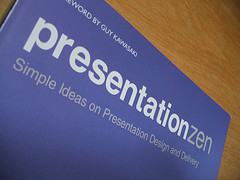
Presentation Zen book coverNeed advice for planning and laying out your slides? I've had the chance to actually sample in real life and consequently buy the Presentation Zen book from Garr Reynolds back when I was in Cambridge MA to work on the Drupal.org upgrade. After reading it, I decided to make the jump and try this "simplified" slide style, and refrain from overwhelming my audience with too much information. Overloading my slides with information was a mistake I believe I made many times before.

Eventually I've driven the Module development kickstart presentation we prepared and delivered with Peter Wolanin and my portion of the Multilingual Drupal panel with the zen approach in mind for Drupalcon Washington DC. With the development slides, there were lots of source code examples to show, so it was hard to apply these principles, however, with my intro to Drupal core multilanguage, I could quickly skim through a huge amount of knowledge with just summarizing the most important details with impressive slides.

Comparing that to the Do It With Drupal slides I had on the same topic (albeit with a significantly bigger scope), my newer slides have a lot less in themselves, but in turn direct the audience to what I have to tell. As Garr points out, a good slideshow should leave the audience with a desire to learn more. The best strategy to achieve that seems to show off the cool stuff and leave off the details for further exploration. While this might sound unfair at first, realistically, telling everything possible to your audience is not gonna work anyway. The reason you have a presentation is to fire up people and not to educate them with all the details you have under your sleeves.

Garr makes the point that if your slides include all the information you are gonna tell (and you gonna tell a lot), then why would you be there at all? If you treat your slides as if they are the handouts for the conference then you are not required in person. People can just read the printout and move on. To have a great presentation you need to engage your audience, you need to make them focus on you and your message. (And after the event, you can still publish your slides with presenter notes included, so people joining in later can still understand some or all of your points).

These are all just tiny samples of what Garr has to tell, and even these points he presents better, so I'd suggest making the jump, getting the book now and starting to prepare for your next presentation focusing more on your audience instead of your topic. See you in Paris!

It was two weeks ago, that we announced the logo contest for the next Drupalcon, which is going to be in Szeged, Hungary at the end of August. We are glad that we managed to energize the Hungarian and a bit of the international community to come out with ideas. We are at ten logo ideas, and it is only two weeks left (until next week's Friday) to submit your logo suggestions! Keep those coming!

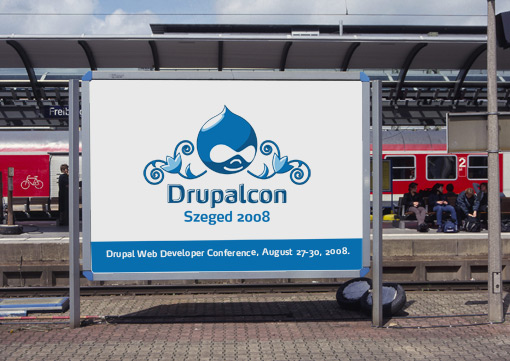
This beautiful Monday morning, a few little presents arrived to the Drupalcon Szeged 2008 website. First entry to the Drupalcon Logo Contest from Ivan Raszl, who based his design on the floral patterns of traditional Hungarian embroidery, porcelain and furniture design. He even went ahead and created some renderings of the logo on several swag and even outdoor advertising. Not that we would be there already to do that for Drupalcons.

And while I was working down my email queue, mag3ee also submitted another entry based on our national colors and the Szeged paprika. Keep these coming or just watch as entries pop up in the list! Note that voting will open when submissions are closed.

In other good news, people from as far as India and Australia are planning to come. Caitlin Johnstone is looking to discuss child care in her forum topic Anyone else looking for childcare? As she explains:

Are there any other Drupal families out there going to Hungary? We thought it would be a good one to bring the kids to since it'll be a bit more intimate than usual, but we need to organise some childcare on the conference days.

Bar bringing someone, I was wondering if we could hire a nanny over there, or perhaps even organise some kid-happy programs if there were enough other families planning to bring their little ones.

Let's see who else is interested in nannies, so that we can suggest and/or help you find suitable service. Reply in the forums.

If you look at the Drupalcon Szeged 2008 website's tracker, you'll see that most announcement posts are attributed to me. This is all too misleading, because in many cases, I am merely channelling information collected and discussed by various organizers to the public website.

This is the first Drupalcon for which the organizers have set up a management website, with the sole purpose to serve the organization team as good as possible, and while it is certainly not perfect, it works well so far. The "Do Drupaltown" website uses the core profile module, the organic groups and casetracker modules, as well as some small helpers like comment upload, upload preview, markdown with smartypants, diff and of course OpenID. Nothing earth-shatteringly special, just trying to work out easy ways to collaborate.

The two basic requirements were to have work groups for specific tasks, in the name of limiting scope and handing out responsibility. An event organized with a thousand attendees expected has so many aspects it is very hard to have a good overview of each aspect. So we have an organic groups setup with some top level groups and several focus groups for tasks like producing (valuable) materials for the registration packages, discussing and solving venue tasks, and so on. Because in numerous cases, we need responsibles to hand out tasks to, organic groups nicely fits with its concept of group ownership and memberships. It also supports mailing updates when new content is published, which is good to drive idle volunteers to the site when things are happening.

Since we are tracking tasks, these also need to have responsibles, an importance level, and a completion status. This allows us to have a running list of important tasks to complete, which helps us focus, know about the status of different jobs and get a distributed team to do that. Case tracker helps us there, it does integration with organic groups, so we can relate tasks to groups, email updates to tasks are mailed and severity and status flags are supported. We also have a patch pending for the views integration to be able to order by task priority, which was a trivial thing we needed to produce lists of tasks from most important down to less important.

Picture of the organizer overviewGiven how distributed our team is (only some people onsite in Szeged, lots of others are around the country elsewhere, while some volunteers from as far as Prague or Belgium), we need a way to reach any given member of the team when we are in a pressing need. We use the core profile module, which provides enough features for us to collect skype names, phone numbers, living locations, and so on, and it builds up a volunteer overview page, which gives us instant access to the contact information of anybody in our team. The only little glitch with profile module is that the number of volunteers grew above 20, so it does not fit on one page by default. Talk about sweet problems...

All-in all, our volunteers are happily working towards completing our goals, and we are marching on to come out with new exciting things for you regularly. Now that the public website of Drupalcon Szeged 2008 is building out, you will notice the volunteers themselves more there too, not just through my filtering.

It looks like the list of sessions for DrupalCon Boston is finalized, so I am happy to announce, that we are going to have a Multilanguage Drupal: a status report and a discussion session, which is going to cover the current state of Drupal 6 and a short overview of contributed modules, and should end up in a vibrant discussion on where Drupal 7 is headed as far as language support goes. There is a huge interest in multilingual support with around 20 modules hosted on drupal.org already. Come and discuss where Drupal is heading, Drupal 7 is in need of hands to advance in this area.

While most of what Drupal core lacks is user entered content translation and localization, and the above session will focus on this, I also added a BoF suggestion which deals with (built-in) interface localization exclusively. Localization tools for Drupal teams and users is expected to focus on tools like l10n_client and l10n_server and related technologies.

In my working hours, I am busy with better support for WYSIWYG editors in Drupal 7 these days, so I am co-hosting a working group BoF with Doug Green titled WYSIWYG Working Group for 7.x core which should be a discussion of proposals on fixing current WYSIWYG integration problems and weaknesses.

At last but not least, Kristof Van Tomme is proposing Szeged, Hungary for DrupalCon Europe 2008, and he intends to hold a discussion BoF on this. The Drupal Association also intends to have a discussion meeting (not open for the public) on the next DrupalCon, so whether this BoF happens is still to be seen. In any case, I am one of the firm supporters of a DrupalCon in Szeged, and I am confident Kristof would be able to lead effectively to get it done in good quality. The easily digestable version of the proposal is up at Proposing Szeged, Hungary for Drupalcon Europe 2008 (look for the attached PDF).

And, well, honestly this is all just peanuts to what all DrupalCon Boston has to offer. So if you are still wondering, whether to go or not to go, make sure you reserve your place! It's a must.

The news is out! The spring DrupalCon in 2008 (these spring events usually being in North America) will be in Boston! While the session program is still in the planning, one slightly hidden announcement is the conference logo contest posted: http://boston2008.drupalcon.org/logoDesignContest The page contains all the important details, the most important being that the deadline is January 25, 2008. Quite close, right? So if you are interested go and take the challenge! The previous conference logo was also designed and decided on through the same process. Looks like Konstantin Kaefer is first to post a design. Be the next!

Dries Knapen just posted about the 200th registration for DrupalCon Barcelona:

We just had our 200th registrant signing up for DrupalCon Barcelona. This is great news, and I'm sure a lot of other people are planning on joining us as well.

Yes, that 200th registrant was me. I was struggling with my bank for more then a month to get my cards (including a virtual MasterCard, which allows me to pay online as securely as possible finally). Then I was away for a week on holiday, so just as I am back, I noticed I can be the 200th registrant which was a good spot to catch :)

The organizers plan for 400 attendees, so 200 registrants a month and a half early seems to be quite fine. The registration is wide open, and session proposals are also accepted. Seems like I'll be involved with at least the following sessions if all end up in the final program:

  • Multilingual Drupal: A big session about how you can make your site multilingual (with both core and contrib functionality) and what changed in Drupal 6. This fits into a pair of session spots with a break, as there are lots of stuff to talk about. I'll co-present this with Jose A Reyero and Ian Ward.
  • Translating Drupal (the new way), where I'll present the results of my Google Summer of Code work: a web based translation system for Drupal project translations; as well as show best practices on how one can make his theme or module translatable.
  • Drupal SoC Showcase, where I'll present a small intro to what I have done and direct listeners to the full featured presentation. There were lots of summer of code projects and so short time to fit all into one session.

Let's make sure that we can meet in Barcelona: register yourself for the conference, if you have not done already, and vote for the above sessions to make the final list.

This year, for the first time, a big two day Drupal event is going to be organized in Sankt Augustin, Germany as part of the FrOSCon 2007 conference (25th-26th August, 2007). Robert Douglass has more to say on this on the dedicated Drupal group, looking for speakers and sponsors for the event. The call for papers deadline of FrOSCon is closing up, you only have one week to propose a session on Drupal (or any other FrOSCon fitting topic) for the conference! Update: The Drupal session submission deadline for FrOSCon was extended to 1st July!

In the meantime, the organizers of Drupalcon Barcelona 2007 (19th-22nd September, 2007) are going forward too. The web registration is already open, which allows you to send a session proposal to the organizers. Although it is not clearly communicated whether the so-called "web registration" actually means a conference attendance registration too. The session description field also sports a limited WYSIWYG editor, which I don't think was a very good idea, but anyway, let those sessions go in! On a related note, Drupalcon Barcelona also has a design contest for the conference logo, which will be printed on t-shirts, name tags, leaflets and so on. This design contest dealine is even closer, only three days left to participate! The design contest deadline was extended until June 10th, and some nice proposals are already in!

Being an organizer of several conferences here in Hungary, I very much appreciate the work that goes into organizing these great events, and I can't wait to be there to meet some Drupal developers I did not meet for some time now (or even not at all)!